
- English
- Arabic

In This Blog Post
Share This Article
- Published: Jun 8, 2026
- Last Updated: Sep 5, 2026
- 🔊 Listen
TL;DR
- Accounts Receivable (AR) represents the money your customers owe your business, while Accounts Payable (AP) refers to the money your business owes suppliers and vendors.
- Effective AP management helps preserve supplier relationships, avoid late payment penalties, and optimize working capital.
- In the UAE, proper invoicing and record-keeping are essential to remain compliant with VAT and corporate tax requirements.
- The UAE's e-invoicing initiative is transforming financial operations, making digital invoice management increasingly important for businesses of all sizes.
Managing cash flow effectively starts with understanding Accounts Receivable (AR), the money your customers owe you. In the UAE’s evolving financial landscape, proper AR management ensures liquidity, regulatory compliance, and strategic decision-making for businesses of all sizes.
This guide explores AR processes, highlights UAE-specific rules like VAT, e-invoicing, and corporate tax, and provides actionable best practices. By mastering AR, companies can reduce financial risk, optimize working capital, and leverage insights to drive smarter business operations and sustainable growth.

Fix Your AR Strategy Today
Stop Late Payments, Cash Flow Gaps & Revenue Losses in the UAE Now
What Is Accounts Receivable for UAE Businesses
Accounts receivable (AR) is the money your customers owe you for goods or services you have already delivered but have not yet been paid for. When you issue an invoice and your customer has not yet paid, that invoice becomes an asset on your balance sheet under the accounts receivable line.
Think of it this way: you have earned the revenue, but you have not yet collected the cash. Until the payment arrives, that amount lives in AR.
AR vs Accounts Payable: What Is the Difference?
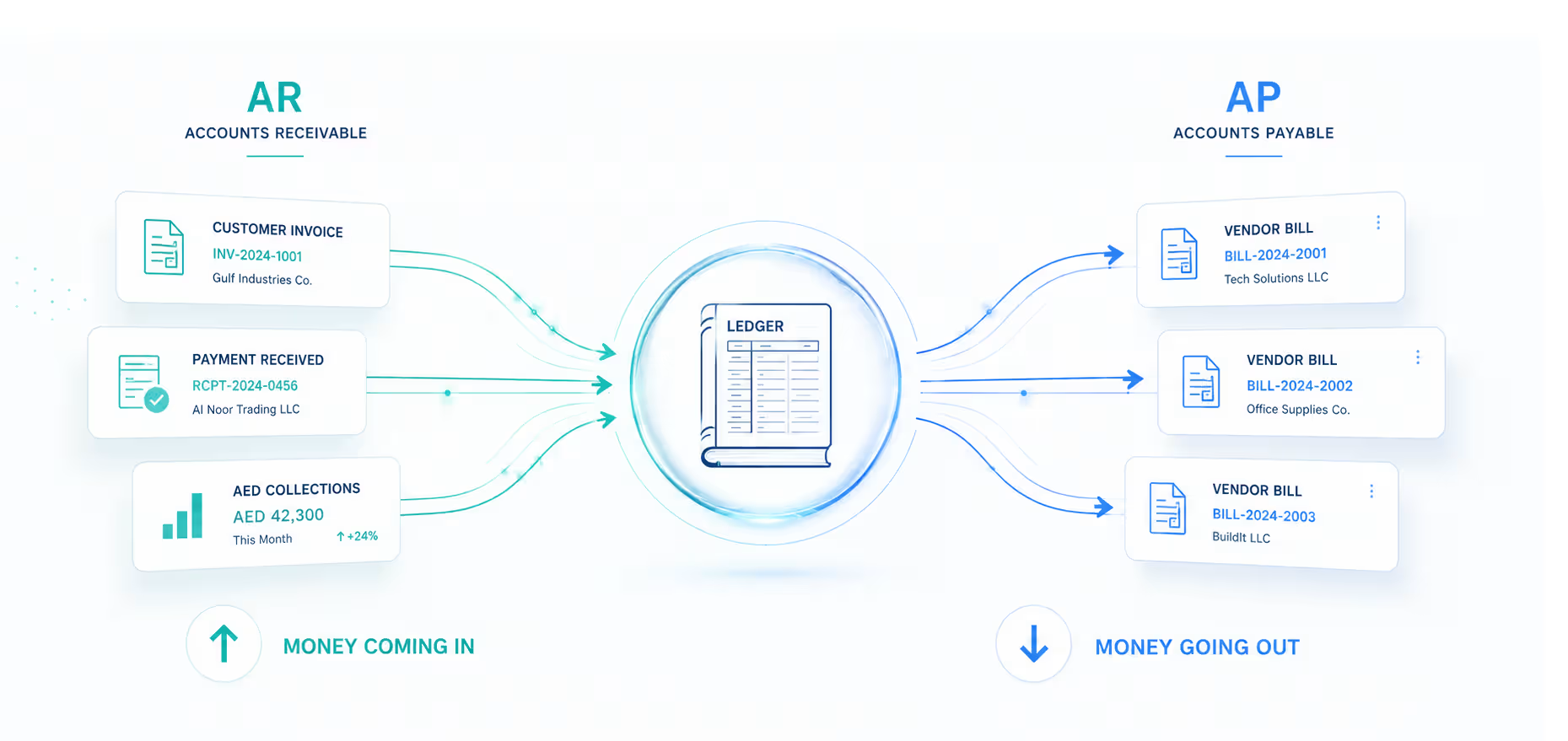
These two terms are often confused, particularly by business owners who are new to formal accounting.
Accounts receivable is money owed to you from your customers. It is an asset.
Accounts payable is money you owe to others, your suppliers and vendors. It is a liability.
In practice, AR happens first if you sell a product or service and then bill the customer. Accounts payable shows up when you are buying something from a supplier on credit. The timing distinction matters enormously in the UAE because it can affect financial reporting, VAT obligations, and overall cash flow management. Businesses should ensure that transactions are recorded correctly under the applicable UAE tax and accounting rules.
Where AR Sits in Your Financial Statements
On your balance sheet, AR appears under current assets, it is expected to convert to cash within 12 months. On your income statement, the corresponding revenue is recognised when the sale occurs, not when the cash is received (under accrual accounting, which the UAE’s corporate tax framework follows).
This timing gap between revenue recognition and cash collection is precisely why AR management matters so much. A company can be profitable on paper and still run out of cash if its receivables are slow to collect.
Why AR Management Is Especially Critical in the UAE
Effective accounts receivable management in the UAE ensures compliance with VAT timing rules, accommodates diverse payment norms, handles post-dated cheques, navigates free zone vs mainland complexities, and secures sufficient cash for corporate tax obligations. Here are several factors making AR more complex in the UAE than in many other markets:
- VAT timing rules: Under UAE VAT legislation, the time of supply is determined by specific statutory rules that consider factors such as the date of supply, the date a tax invoice is issued, and the date payment is received. Businesses should ensure tax invoices are generally issued within 14 days of the date of supply, as required by UAE VAT regulations.
- Multi-cultural payment norms: The UAE’s business community spans dozens of nationalities, each with different expectations around payment timelines and collection etiquette.
- Post-dated cheques: Still common in sectors like real estate and construction, these create a unique AR dynamic not seen in most Western markets.
- Free zone vs mainland complexity: Transactions between mainland and free zone entities can have different VAT treatment, requiring careful invoice classification.
- New corporate tax: Since June 2023, UAE businesses have been subject to a 9% corporate tax on profits exceeding AED 375,000. Poorly managed AR directly affects taxable income calculations and cash available for tax payments.
A Quick Example: A Dubai Trading Company’s AR Cycle
Imagine a trading company in Jebel Ali Free Zone that sells industrial equipment to a mainland Dubai contractor. The goods are delivered on 1 April. An invoice for AED 500,000 (plus 5% VAT = AED 25,000) is issued on 5 April. Payment terms are 45 days, meaning payment is due on 20 May.
From the moment the invoice is issued:
- The AED 500,000 sits in accounts receivable as a current asset
- The AED 25,000 VAT is owed to the FTA in the relevant VAT return period
- If payment has not arrived by 20 May, the business is carrying a late receivable
- If it is still unpaid at 90 days, it may need to be provisioned as a doubtful debt
Managing this well, from the invoice date to the collection date, is what AR management is about.
The AR Process: How It Works End-to-End in a UAE Business
Every payment you receive follows a structured accounts receivable journey, from checking a customer’s creditworthiness to reconciling the final payment. Understanding each stage of the AR process helps UAE businesses improve cash flow, minimize bad debts, and stay compliant with VAT regulations.
Stage 1: Credit Assessment Before You Sell
Before extending credit terms to a new customer, a sound business will assess their creditworthiness. In the UAE context this means:
- Reviewing their trade licence and company registration
- Checking their payment history through referrals or credit bureaus (Al Etihad Credit Bureau is the UAE’s national credit bureau)
- Setting a credit limit appropriate to their financial capacity
- Documenting agreed payment terms in a signed contract or purchase order
Many UAE businesses skip this step entirely with new customers, particularly when eager to close a deal. This is the single biggest cause of bad debt.
Stage 2: Service Delivery and Documentation
Before an invoice can be issued, the underlying supply must be complete and documented. Best practice in the UAE includes:
- A signed delivery note or goods receipt confirmation
- A completion certificate or service acceptance document for project work
- A purchase order number from the customer (many government and large corporate buyers require PO matching before approving invoices)
Without these documents, customers have grounds to delay payment under the guise of disputes, and they often use them.
Stage 3: Invoice Issuance
Under UAE VAT law, a tax invoice must be issued within 14 days of the date of supply. Missing this window creates both a compliance issue (potential FTA penalties) and a practical one. The longer you wait to invoice, the longer you wait to be paid. A compliant UAE VAT invoice must include:
- The word “Tax Invoice” prominently displayed
- Your Tax Registration Number (TRN)
- Your customer’s TRN (for B2B transactions above AED 10,000)
- A sequential invoice number
- Date of supply and date of invoice
- Description of goods or services
- Unit price, quantity, and total amount
- VAT rate applied (5% for standard-rated, 0% for zero-rated, or exempt)
- VAT amount in AED
- Total amount payable in AED
For transactions below AED 10,000, a simplified tax invoice may be used, which has fewer mandatory fields.
Stage 4: Payment Terms and Norms in the UAE
Payment terms across UAE industries vary significantly:
| Sector | Common Payment Terms |
|---|---|
| Government contracts | 30–90 days (sometimes longer) |
| Large corporates | 45–60 days |
| SME-to-SME | 30–45 days |
| Real estate / construction | Milestone-based or post-dated cheques |
| Retail and FMCG | 30 days or cash on delivery |
| Professional services | 30 days or upon delivery |
One important nuance: agreeing to 30-day terms does not mean customers will pay in 30 days. For many UAE businesses, actual collection takes 60 to 90 days. Building this reality into your cash flow forecasting is essential.
Stage 5: The Collections Process (Dunning)
Once an invoice is issued, a structured follow-up process known as dunning is what separates businesses with healthy cash flow from those that perpetually struggle.
A well-designed dunning sequence for UAE businesses might look like this:
- Day 1: Invoice issued and emailed with PDF attachment. Confirm receipt if dealing with a large corporate.
- Day 7: Courtesy email check-in. Confirm the invoice has been received and is in the approval process.
- Day 30 (payment due date): Final reminder before the due date. Polite but explicit.
- Day 7 after due date: First overdue notice. Reference to the invoice number, amount, and original due date. Request a payment date of commitment.
- Day 30 after due date: Second overdue notice. Escalate to a senior contact if the primary contact has been unresponsive.
- Day 60 after due date: Final notice. Reference next steps including suspension of credit or referral to a collections specialist.
- Day 90 after due date: Consider legal notice or assignment to a collections agency.
Stage 6: Cash Application and Reconciliation
When payment is received, it must be applied correctly to the corresponding invoice(s) in your accounting system. This sounds simple but becomes complex when:
- Customers pay multiple invoices in a single transfer
- Partial payments are made
- Customers deduct unauthorized discounts or short pay
- Bank charges reduce the transfer amount
Maintaining a clean AR ledger requires reconciling your bank statements against your AR module regularly ideally weekly.
What is E-Invoicing and How it Impacts AR Process?
UAE e-invoicing is not simply sending invoices by email or as a PDF. It requires invoices to be created in a structured XML format (Peppol PINT-AE standard), transmitted through an FTA-accredited service provider, and reported to the Federal Tax Authority in real-time.
Traditional PDF invoices will no longer be compliant once the mandate takes effect.
The legal basis
The framework is established under Ministerial Decision No. 243 of 2025 and Ministerial Decision No. 244 of 2025, issued on 28 September 2025. These decisions establish the UAE’s Decentralized Continuous Transaction Control and Exchange (DCTCE) model, commonly known as the “5-corner” model, based on the international Peppol network.
The rollout timeline
| Phase | Date | Who Is Affected |
|---|---|---|
| Voluntary adoption | 1 July 2026 | All VAT-registered businesses |
| Large businesses mandatory | 1 January 2027 | Annual revenue above AED 50 million |
| SME mandatory | 1 July 2027 | All remaining in-scope businesses |
What does compliance require?
- Appoint an Accredited Service Provider (ASP): All e-invoices must flow through an FTA-accredited ASP connected to the Peppol network. Large businesses must appoint an ASP by 31 July 2026; smaller businesses by 31 March 2027.
- Issue invoices in Peppol PINT-AE XML format: Your ERP or accounting software must be capable of generating structured XML invoices.
- 14-day reporting window: Invoice data must be reported to the FTA within 14 days of the date of the taxable transaction. This is independent of the quarterly VAT return cycle.
- Secure storage: Both the sender and recipient must retain e-invoices in a complete, accessible format for FTA audit purposes.
Penalties for non-compliance
Under Cabinet Decision No. 106 of 2025:
- AED 5,000 per month for failing to appoint an accredited service provider
- AED 100 per invoice issued outside the e-invoicing system after the go-live date
- Additional penalties for failing to report system failures within two business days
- Possible disallowance of input VAT claims if invoices cannot be verified in the system
What this means for your AR team
The e-invoicing mandate fundamentally changes the AR workflow. Your AR team will need to:
- Ensure all customer records include Peppol participant identifiers (where available)
- Generate invoices in compliant XML format through integrated software
- Confirm delivery and FTA reporting acknowledgements for each invoice
- Update collection processes to reference e-invoice IDs rather than PDF invoice numbers
The silver lining: businesses that implement e-invoicing properly will see faster invoice delivery, fewer disputes over receipt, and a foundation for further AR automation.
Key AR Metrics Every UAE Business Should Track
Tracking the right accounts receivable metrics helps UAE businesses measure collection performance, strengthen cash flow, and identify payment risks before they become bad debts. The five KPIs below provide a clear view of your overall AR health.
1. Days Sales Outstanding (DSO)
It is the average number of days it takes to collect payment after a sale.
Formula: (Accounts Receivable ÷ Total Credit Sales) × Number of Days
A DSO above 90 days is a serious warning sign. Businesses targeting best-in-class performance should aim for DSO below 45 days.
Every extra day of DSO represents working capital tied up in unpaid invoices. For a business with AED 10 million in monthly revenue, reducing DSO from 75 days to 45 days frees up approximately AED 10 million in cash.
2. Collection Effectiveness Index (CEI)
CEI is the percentage of receivables that were actually collected during a period, relative to the amount available to collect.
Formula: ((Beginning AR + Credit Sales − Ending AR) ÷ (Beginning AR + Credit Sales − Ending Current AR)) × 100
A CEI above 95% indicates a healthy, well-functioning collections system. A drop below 80% is a signal to review your collections process immediately.
3. Accounts Receivable Turnover Ratio
This ratio measures how many times per year your business collects its average AR balance.
Formula: Net Credit Sales ÷ Average Accounts Receivable
A ratio of 6 means you collect your entire AR balance six times per year (every two months on average). A ratio of 12 means you collect monthly. A higher ratio means faster collection. This metric is particularly useful for year-over-year trend analysis and for comparing performance within your industry.
4. Accounts Receivable Aging
The metric is the breakdown of outstanding invoices by how long they have been unpaid.
Standard aging buckets:
- Current (0–30 days)
- 31–60 days overdue
- 61–90 days overdue
- 91–120 days overdue
- 120+ days overdue
The older a receivable, the less likely it is to be collected. Industry data consistently shows that invoices over 90 days old have a significantly lower recovery rate than current invoices. Regular aging analysis identifies which customers need escalation and which debts may need to be provisioned.
5. Bad Debt to Sales Ratio
It is the proportion of total sales that are ultimately written off as irrecoverable.
Formula: Bad Debt Write-Offs ÷ Total Sales × 100
Most healthy businesses maintain a bad debt ratio below 1–2%. Anything above 3% suggests a systemic problem with credit assessment or collections.
Under UAE corporate tax rules, specific bad debt write-offs may be deductible, but only if proper documentation exists confirming that recovery efforts have been exhausted. Tracking this metric and maintaining supporting evidence is important for tax compliance.
Common AR Challenges Facing UAE Businesses and How to Fix Them
The most common accounts receivable challenges for UAE businesses include late payments, multi-currency receivables, VAT complexities, relationship-driven collections, manual invoicing errors, weak credit policies, and cross-border collections. Addressing these issues with clear processes and automation can significantly improve cash flow and reduce bad debts.

Challenge 1: Late Payments Are the Default, Not the Exception
Many customers treat payment terms as a starting point for negotiation rather than a contractual obligation. Some large buyers have internal payment approval processes that take 45 to 90 days regardless of agreed terms. Others simply manage their own cash flow at the expense of their suppliers.
How to fix it:
- Include late payment interest clauses in your contracts (UAE law permits this)
- Offer an early payment discount (1–2% for payment within 10 days can be highly effective)
- Implement a strict credit hold policy: no new work or goods delivered if a customer has invoices more than 60 days overdue
- Use automated reminder sequences so follow-up never falls through the cracks
Challenge 2: Multi-Currency Receivables
The reality: Many UAE businesses sell internationally to GCC neighbours such as India, Europe, or the US and may invoice in USD, EUR, or other currencies. If your functional currency is AED and your receivable is in USD, any movement in the exchange rate between invoice date and payment date creates a foreign exchange gain or loss. Under corporate tax rules, these gains and losses affect taxable income.
How to fix it:
- Invoice in AED wherever possible to eliminate FX risk
- If invoicing in foreign currencies, consider forward contracts or natural hedging
- Ensure your accounting system tracks FX revaluation of AR balances at each period end
Challenge 3: Free Zone vs Mainland VAT Complexity
The reality: A significant number of UAE businesses operate in or transact with free zones, which have different VAT treatment from mainland entities. It paves the way for common pitfalls including:
- Applying 5% VAT on supplies to a designated free zone
- Failing to obtain evidence that goods physically entered the free zone
- Incorrectly treating all free zone-to-mainland transactions as zero-rated
How to fix it: Review your customer base and classify each customer as mainland, designated free zone, or non-designated free zone. Apply the correct VAT treatment on each invoice. When in doubt, take specialist VAT advice; the cost of a wrong classification can far exceed the cost of professional guidance.
Challenge 4: Relationship-Based Payment Culture
Direct, aggressive collection calls can permanently damage a client’s relationship and in a market where referrals matter enormously; that damage has long-term consequences.
How to navigate it:
- Use written reminders (email, WhatsApp) as the first line of follow-up, they are professional and create a paper trail without confrontation
- For high-value clients, have senior management handle overdue conversations personally
- Frame collection calls around “helping resolve any issues with the invoice” rather than demanding payment
- Separate the collections relationship from the service delivery relationship wherever possible
Challenge 5: Manual Invoicing Errors
The reality: When invoices are created manually in Excel, Word, or basic accounting software, errors are inevitable. Wrong TRN numbers, incorrect VAT calculations, missing mandatory fields, and duplicate invoice numbers are all common.
How to fix it: Implement accounting software that auto-populates customer data, calculates VAT correctly, and generates sequential invoice numbers. The time saved on corrections and disputes pays for itself quickly.
Challenge 6: No Formal Credit Policy
Many UAE SMEs extend credit informally based on intuition or relationships without a written credit policy. Without documented credit limits, payment terms, and escalation procedures, collecting overdue amounts becomes a matter of negotiation rather than contract enforcement.
How to fix it: Create a one-page credit policy that sets out: maximum credit limits by customer tier, standard payment terms, conditions for extending longer terms, and the escalation process for overdue accounts. Make sure it is referenced in every customer contract and sales agreement.
Challenge 7: Cross-Border Receivables
The reality: UAE businesses that supply to Saudi Arabia, Kuwait, Oman, and other GCC countries or to international customers, face additional complexity. Different legal systems, different VAT regimes, and different enforcement mechanisms make collection more difficult.
How to manage it:
- Always obtain a signed contract or purchase order before delivering across borders
- Consider requiring advance payment or a letter of credit from new international customers
- For GCC supplies, understand whether supplies are zero-rated under UAE VAT and document accordingly
- For aged cross-border receivables, specialist debt recovery firms with regional expertise may be more effective than pursuing through UAE courts
AR Automation in the UAE: What Has Changed and What Is Coming
The UAE’s accounts receivable landscape is transforming. Two forces are driving this simultaneously: the government’s e-invoicing mandate, which requires structured digital invoicing for all businesses by 2027, and the availability of AI-powered AR tools that are increasingly accessible even for SMEs.
Businesses that have adopted AR automation reported a reduction in DSO, and inaccuracies. For many UAE finance teams, accounting automation has become the practical bridge between e-invoicing compliance and day-to-day AR efficiency, streamlining everything from invoice generation and payment matching to collections follow-up and reconciliation in one connected workflow.
On the other hand, those still operating on spreadsheets and manual invoice creation face growing compliance risk as the e-invoicing deadline approaches.
How AR Automation Works
AR automation streamlines the entire accounts receivable cycle by using technology to automate invoicing, payment reminders, collections, and cash reconciliation. For UAE businesses, modern AR platforms also support e-invoicing compliance, real-time reporting, and AI-driven payment predictions to improve cash flow and reduce manual effort.
- Automated invoicing: Invoice templates connected to your CRM or ERP auto-generate invoices when a sale is completed, pulling in customer data, TRN numbers, and correct VAT treatment automatically.
- E-invoicing integration: From 2026, this means connecting to an FTA-accredited ASP and automatically transmitting XML invoices through the Peppol network. The best platforms handle this in the background with no additional effort from the AR team.
- Automated reminders: Pre-set reminder sequences fire at configured intervals before and after the due date. Reminders can be customised by customer tier, invoice amount, and relationship status.
- AI-powered payment prediction: Some platforms use machine learning to predict which invoices are at risk of late payment based on historical customer behaviour, allowing collections teams to focus their effort where it is most needed.
- Real-time AR dashboards: Live visibility into DSO, aging buckets, CEI, and cash collection forecasts, updated in real time rather than requiring manual report generation.
- Cash application: Automatic matching of incoming bank payments to outstanding invoices, including handling partial payments and identifying short pays.
In-House vs Outsourced AR: What Makes Sense for UAE SMEs?
One of the most common decisions UAE business owners faces as they grow is whether to build an in-house AR function or outsource it. There is no universal right answer, but there is a framework for thinking it through.
The Case for In-House AR
An in-house AR team makes sense when:
- Your business has high invoice volumes that require continuous daily attention
- Your customers are highly relationship-sensitive and require a consistent, personal collections touch
- Your AR function is closely integrated with other finance operations (credit, treasury, reporting)
- You have sufficient volume to justify the overhead (typically 200+ invoices per month, or AR balances above AED 5 million)
In-house AR gives you full control, immediate responsiveness, and the ability to deeply integrate AR with the rest of your business.
The cost, however, is real: a dedicated AR specialist in Dubai can command AED 8,000–15,000 per month, plus overheads, software, and management time.
The Case for Outsourced AR
Outsourcing AR to an accounting or AR management firm in the UAE makes sense when:
- You are a startup or early-stage business that does not yet have the volume to justify dedicated headcount
- Your business is growing and AR complexity is increasing faster than your team’s capacity
- You want immediate access to UAE-specific compliance expertise without hiring and training costs
- You are approaching the e-invoicing mandate deadline and need experienced implementation support
Outsourced AR is typically more cost-effective than in-house for businesses with fewer than 150–200 monthly invoices. You get professional expertise, scalable capacity, and compliance assurance at a fraction of the cost of a dedicated hire.
What an Outsourced AR Provider Should Handle
A good, outsourced AR provider should function as an extension of your finance team, handling not just collections but also compliance, reporting, and day-to-day receivables management. In the UAE, where VAT and e-invoicing requirements add another layer of complexity, your provider should be able to manage the following:
- Invoice preparation and issuance (including VAT-compliant formatting and, from 2027, e-invoicing)
- Customer TRN verification and credit record maintenance
- Automated and personalised payment reminders
- Dispute identification and escalation to your team
- Cash application and reconciliation
- Weekly AR aging reports
- Quarterly KPI reporting (DSO, CEI, aging analysis)
- FTA compliance support: documentation for bad debt claims, audit preparation
Scale Your Business with Smarter Accounts Receivable Management
A well-managed accounts receivable process does more than accelerate collections; it strengthens cash flow, reduces bad debts, and gives your business the financial flexibility to grow. By combining clear credit policies, timely invoicing, structured follow-ups, and accurate reporting, UAE businesses can turn their receivables into a strategic advantage.
At Whiz Consulting, we help businesses streamline their accounts receivable operations through experienced finance professionals and technology-enabled processes. From invoice management and collections to AR reporting and reconciliations, we help you improve cash flow while staying focused on growth.

Get customized plan that supports your growth

Have questions in mind? Find answers here...
The most common payment terms in the UAE are 30 to 60 days. However, actual collection times frequently exceed agreed terms; the national average Days Sales Outstanding is above 60 days for many industries. Government and large corporate buyers often operate on 45–90-day internal payment cycles regardless of contracted terms.
A free zone company that is VAT-registered and has charged output VAT on a supply may be eligible to claim a bad debt adjustment if the receivable remains unpaid after six months and all reasonable recovery steps have been taken. However, the rules are complex, and eligibility depends on the nature of the supply, the free zone’s VAT registration status, and compliance with FTA documentation requirements. Professional VAT advice is strongly recommended.
“Accounts receivable” and “trade debtors” refer to the same thing amounts owed by customers for goods or services. In UAE financial statements prepared under IFRS, the more common term is “trade receivables” or “trade and other receivables.” The terms are interchangeable in practice. Both represent current assets owed to the business by its customers.
The most effective strategies for reducing DSO in Dubai are: invoicing immediately after delivery rather than at month-end; implementing automated payment reminder sequences; enforcing a credit hold policy for overdue customers; offering early payment discounts to incentivise prompt settlement; and reviewing your credit terms for high-risk customers. Technology-based AR automation typically reduces DSO by 25–35% within the first year of implementation.
Post-dated cheques (PDCs) are cheques issued today with a future date, they are common in UAE real estate, construction, and some retail sectors. A PDC sitting in your drawer represents money you expect to receive but have not yet collected. In AR terms, PDCs are typically recorded as receivables and tracked by maturity date. When a cheque bounces, it converts to an overdue receivable.
Thousands of business owners trust Whiz to manage their account
Let us take care of your books and make this financial year a good one.